

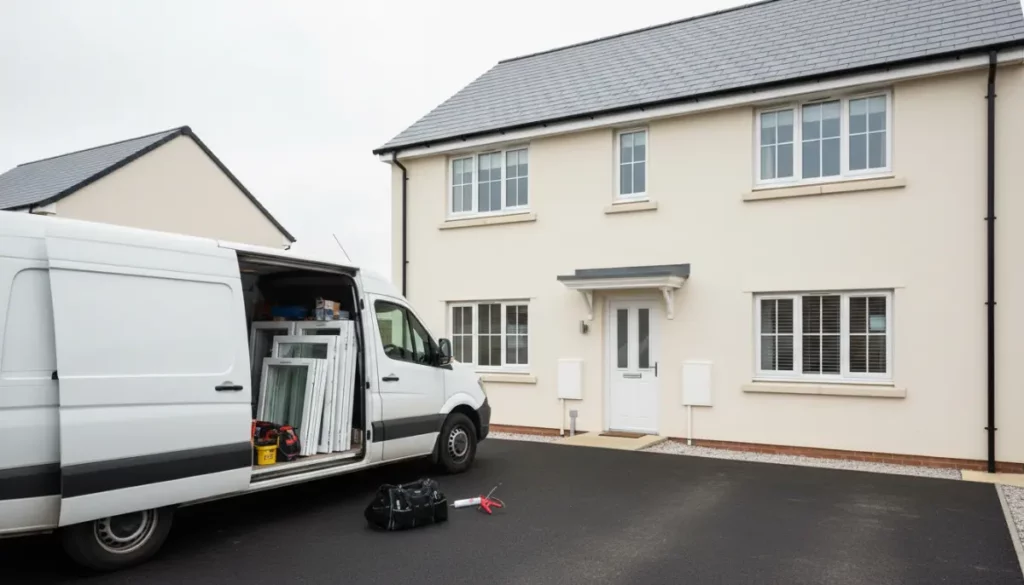
The vast majority of people who order supply-only windows are not planning to fit them themselves. They want the savings that come from buying direct at trade prices, but they still want a professional to handle the installation. Finding a local window fitter who is comfortable working with supply-only orders is the step that makes the whole model work.
This guide covers where to search, what to ask before hiring, how to check whether a fitter is properly registered, and what labour costs to expect for window installation across different job types.
Why Many Window Supply Direct Customers Use a Local Fitter
The supply-only model does not require you to self-install. It simply separates the product purchase from the installation. You buy the uPVC windows at trade prices direct from Window Supply Direct. You then hire a local window fitter to carry out the installation separately. This is how the majority of homeowners who replace windows through Window Supply Direct approach the project.
This split is where the saving comes from. When you buy from a national installer, a significant portion of what you pay covers their showroom, sales team, survey visit, and brand overhead. None of that applies when you source the product yourself and appoint your own fitter. Window installers who work on a labour-only basis typically charge £100 to £200 per window, far below what is embedded in a full supply-and-fit quote from a national double glazing company. Over a full house of new windows, the difference in energy bills and upfront cost compared to staying with old, inefficient frames is considerable.
The product itself is the same. Window Supply Direct windows are manufactured using Veka Halo, Eurocell, Rehau, and Synseal uPVC profiles with Pilkington glass. These are the same profile systems used by professional window companies across the UK. A competent local fitter is likely to have worked with them before.
Where to Find a Local Window Fitter for Supply-Only Work
Checkatrade and Rated People
Checkatrade and Rated People are the most widely used platforms for finding vetted local tradespeople in the UK. Both allow you to search by location, read verified customer reviews, and request quotes from multiple fitters in your area. Search specifically for 'window fitter' or 'window installer' rather than double glazing companies, which are more likely to be supply-and-fit operations with their own product ranges.
When you contact a fitter through either platform, state clearly in your initial message that the windows are supply-only and that you need labour only. Not all window fitters take on supply-only work. Filtering for those who do at the enquiry stage saves time.
MyBuilder
MyBuilder operates similarly to Checkatrade and Rated People but uses a job-posting model where tradespeople contact you rather than the other way around. Post a description of the project, specifying supply-only windows and the number of windows to be installed, and local window fitters in your area can respond with a quote. This is useful for comparing quotes across several fitters without making individual calls.
Local Recommendations
Word of mouth remains reliable for trade work. Ask neighbours, family, or local community groups whether they have used a local window fitter for a similar project. A recommendation from someone who has used the same fitter for a supply-only job removes a significant amount of the uncertainty around whether the fitter is comfortable with the arrangement.
Local Independent Window Companies
Not all window companies are national installers with a fixed product range. Many local window companies are prepared to install customer-supplied windows as a labour-only job. Search for local window companies in your area and call to ask directly whether they carry out supply-only installation. Smaller independent operators are often more flexible than larger franchise operations.
Builder Networks and Trade Counters
Local builders and general contractors often have established relationships with window fitters. If you are already working with a builder on a broader renovation project, ask whether they have a recommended fitter they work with regularly. Similarly, trade counters in your area, where professionals buy materials, may be able to point you towards independent fitters who operate locally.
What to Ask a Window Fitter Before You Hire
Not every window fitter is set up to handle supply-only work, and not every fitter is equally experienced across all window types. These are the questions worth asking before you commit:
- Are you FENSA or CERTASS registered? A FENSA or CERTASS registered fitter can self-certify that the installation complies with building regulations under the competent person scheme. This means they handle the compliance paperwork and notify the local council on your behalf, saving you the separate step of going through local authority Building Control.
- Have you installed supply-only windows before? Experience with the supply-only model matters. A fitter who has worked this way before understands that they are responsible for the installation rather than the product, and knows how to handle the job without the manufacturer's installation instructions being provided by a sales rep.
- Are you experienced with the window type I am fitting? Sash windows, bay windows, and tilt and turn windows each present different installation challenges. Confirm the fitter has installed the specific style you are ordering.
- What is your day rate or per-window rate? Get the labour cost broken down clearly before the job starts. Day rate and per-window rate can vary significantly, and a fitter who charges a low day rate but takes longer per window may cost more overall. Ask what the rate covers: whether it includes making good around the frames, disposing of old windows, and sealing.
- Do you carry public liability insurance? Any professional carrying out installation work on your property should have public liability insurance in place. Ask to see evidence of cover before the job starts.
- What access do you need? Upper-floor windows may require scaffolding or a tower. Clarify whether the fitter supplies this as part of the job or whether you need to arrange it separately.
How to Check FENSA and CERTASS Registration
Both FENSA and CERTASS maintain public registers of approved installers that you can search online by postcode or company name. Checking registration takes less than two minutes and confirms that the fitter is part of the competent person scheme for window installation.
- FENSA: search the FENSA registered installer database at fensa.org.uk
- CERTASS: search the CERTASS register at certass.co.uk
Registration through either scheme means the fitter can self-certify compliance with building regulations. When they complete the installation, they register the work with the local council and issue you with a certificate. That certificate is your proof of compliance and is the document solicitors ask for when you come to sell the property.
What Does Window Fitter Labour Cost?
Window fitter labour cost varies by location, access requirements, window type, and the number of windows being installed in a single visit. Here are the typical ranges for the UK:
| Job Type | Typical Labour Cost |
|---|---|
| Standard casement window (ground floor) | £100 – £150 per window |
| Casement window (upper floor, no scaffold) | £120 – £180 per window |
| Tilt and turn window | £130 – £200 per window |
| uPVC sash window | £150 – £220 per window |
| Bay window (3-pane) | £300 – £500 per bay unit |
| Full house (8 to 10 windows, single visit) | £900 – £1,800 day rate (negotiable) |
Figures are indicative. Labour costs vary by location, fitter, and access requirements. Always get two or three quotes before committing.
Fitting all the windows in a house as a single job typically reduces the per-window cost. A fitter can work more efficiently across a day with consistent access and a single setup, and most offer a better day rate for a larger project. If you are replacing all windows, ordering and installing in one batch is worth considering.
What a Window Fitter Covers: Supply Only vs Supply and Fit
In a supply-only arrangement, the split of responsibility is clear. Window Supply Direct supplies the windows. The fitter handles everything on site. Understanding this split up front prevents any confusion about who is responsible for what:
| Window Supply Direct (Supplier) | Local Window Fitter | |
|---|---|---|
| Manufactured window units | Yes | No |
| Delivery to site | Yes | No |
| Product guarantee on windows | Yes | No |
| Removal of old windows | No | Yes (confirm before hiring) |
| Installation of new frames | No | Yes |
| Sealing and making good | No | Yes (confirm scope) |
| Building regulations compliance (FENSA/CERTASS) | No | Yes (if registered) |
| Disposal of old frames and glass | No | Yes (confirm before hiring) |
When speaking to a fitter, confirm explicitly whether their quote includes removing the old windows and disposing of the old frames and glass. Some fitters price this separately. Others include it as standard. It is worth nailing down before the job starts rather than after.
What to Tell a Fitter Before They Quote
To get an accurate quote from a local window fitter, provide as much detail as possible upfront. Fitters price based on the scope of the job, and vague briefs lead to vague quotes that can change once work begins. Give them:
- The number of windows being installed
- The window type for each opening: casement, sash, tilt and turn, bay, or other
- The floor level of each window and whether scaffolding or a tower is likely to be needed
- Whether you need old windows removed and disposed of
- The expected lead time on delivery from Window Supply Direct, so they can plan around it
- Whether you need the fitter to be FENSA or CERTASS registered for compliance purposes
The more specific the brief, the more useful the quote. Compare quotes from at least two or three window installers before committing, and compare them on a like-for-like basis: same scope, same number of windows, same access requirements.
Supply Only vs Supply and Fit: What You Are Comparing
When you receive a quote from a national double glazing company or a large local window company offering a full supply-and-fit service, that price includes the product, the survey, the installation, the paperwork, and the company's overhead. The figures below illustrate the typical cost difference for a full house of windows:
| National Installer (Supply and Fit) | Window Supply Direct + Local Fitter (Supply Only) | |
|---|---|---|
| Windows (10 units) | Included in total | Approx. £1,500 – £2,500 + VAT |
| Installation | Included in total | Approx. £1,000 – £1,800 (local fitter) |
| Total estimate | £6,000 – £10,000+ | £2,500 – £4,300 |
| Potential saving | n/a | Often 40 to 60% |
Figures are indicative. Actual cost depends on window specification, number of windows, location, and local fitter rates.
The saving comes from removing the middleman and the overhead attached to it. The uPVC frames, double glazed units, and hardware are equivalent in specification. What changes is how they reach you and who fits them.
Product Guarantees and What They Cover
A common concern with supply-only orders is whether product guarantees are affected. They are not, for the product itself. Window Supply Direct windows carry a manufacturer's guarantee on the uPVC frames and sealed glazing units. That guarantee covers the product as supplied.
What a supply-only product guarantee does not cover is the installation. If a window develops a problem that is caused by how it was fitted rather than a manufacturing defect, that is the fitter's responsibility, not Window Supply Direct's. This is why it is worth confirming that your chosen fitter carries public liability insurance and, where relevant, check whether they offer any warranty on their workmanship.
In practice, a well-made uPVC window installed correctly by a competent fitter should not present problems. The vast majority of issues with double glazed uPVC windows in service relate to sealed unit failure over time, hardware wear, or seal deterioration, none of which are installation issues.
Building Regulations and Supply-Only Windows
Replacing windows in England and Wales requires compliance with building regulations regardless of whether you use a supply-and-fit company or a supply-only route. The regulations cover thermal performance (Part L), ventilation (Part F), safety glazing, and egress requirements in habitable rooms.
The simplest way to handle compliance when using a local fitter is to appoint one who is registered with FENSA or CERTASS. As part of the competent person scheme, they self-certify the installation, notify the local council, and issue you with a compliance certificate. This is the same certificate that a national installer would provide.
If your fitter is not registered, you need to notify local authority Building Control before the installation begins. This is a straightforward process with a typical cost of £100 to £200. The Building Control completion certificate carries the same legal weight as a FENSA certificate. See our full guide on FENSA, building regulations, and supply-only windows for a step-by-step breakdown.
Frequently Asked Questions
Most experienced window fitters can install customer-supplied windows. The key questions are whether they are FENSA or CERTASS registered (for compliance purposes), whether they have experience with the specific window type you are ordering, and whether they are comfortable with the supply-only arrangement where the product guarantee sits with the supplier rather than them.
Search Checkatrade, Rated People, or MyBuilder by postcode and specify 'window fitter' in your search. When making contact, state clearly in your initial message that the windows are supply-only and that you need labour only. Local independent window companies are often more flexible than larger operations and may be open to supply-only installation jobs.
Window fitter labour cost typically runs at £100 to £200 per window for standard casement windows at ground floor level. Upper-floor windows, sash windows, and bay windows cost more due to additional access requirements and installation complexity. A full house fitted in a single visit tends to reduce the per-window cost through a better day rate.
You do not need a FENSA registered fitter, but using one simplifies the compliance process. A FENSA or CERTASS registered fitter handles building regulations compliance on your behalf as part of the competent person scheme. If you use an unregistered fitter, you need to handle compliance through local authority Building Control separately.
The product and its guarantee are Window Supply Direct's responsibility. The installation is the fitter's responsibility. If a window has a manufacturing defect, contact Window Supply Direct. If the window was fitted incorrectly, that is a matter for the fitter. This split is standard in any supply-only arrangement and is why confirming the fitter's public liability insurance before the job starts is sensible.
An experienced window fitter typically takes one to two hours per window for a standard casement replacement. A full house of ten windows could be completed in a single day for a two-person team working efficiently. Bay windows, sash windows, and jobs requiring scaffolding take longer. Ask your fitter for a realistic time estimate before the project begins so you can plan around it.
Order Your Windows and Find Your FitterWindow Supply Direct supplies made-to-measure uPVC windows at trade prices direct to homeowners across the UK. Browse the full range and get an instant quote online without providing any personal details. Windows are priced from £92.42 + VAT, manufactured to order, and delivered direct to site.
Once you have your order confirmed and a delivery date from Window Supply Direct, contact local window fitters and brief them on the job. Giving them the product details, dimensions, and delivery date upfront makes the process straightforward for everyone involved.