

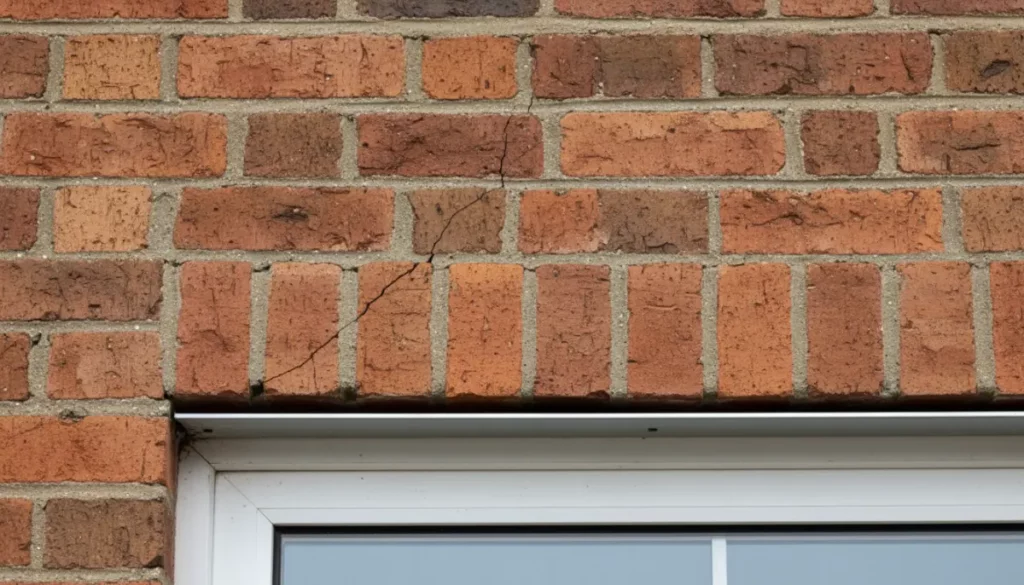
Most window replacements are straightforward. You measure the opening, order the window, remove the old frame, fit the new one. But in a small number of cases, there is something above the window opening that can turn a routine job into a structural problem: a missing, failing, or inadequate lintel.
This guide explains what a lintel does, how to check whether one is present before you start work, what the warning signs of a failing lintel look like, and when the job needs a structural engineer rather than a window fitter.
What Is a Lintel and Why Does It Matter?
A lintel is a horizontal structural element that spans the top of a window or door opening in a load-bearing wall. Its function is to transfer the weight of the wall above the opening to the masonry on either side, so that weight does not bear down directly onto the window frame itself.
Without adequate lintel support, the load from the wall above a window opening has nowhere to go except onto the frame. Over time, this causes the frame to distort, the surrounding brickwork to crack, and in more serious cases, the masonry above the opening to sag or shift. The structural integrity of that section of wall depends on the lintel doing its job correctly.
This matters particularly for replacement windows because removing an existing window frame, even temporarily, can disturb whatever load arrangement is currently in place. If the existing frame has been providing unintended structural support because no proper lintel exists above it, removing the frame without addressing that creates a risk.
Types of Lintel: What You Are Looking For
Modern window lintels are typically made from steel or concrete. Steel lintels are the most common type in modern UK masonry construction, valued for their strength and the slim profile they allow. This is consistent with standard UK construction practice as outlined in guidance published by the Steel Construction Institute and recognised by Building Regulations Part A. Concrete lintels are used for heavier loads and wider spans. In older buildings, you may find timber lintels, stone lintels, or in some cases, no lintel at all, with the window frame or an arched brick arrangement carrying the load instead.
| Lintel Type | Common In | What to Look For | Risk Level |
|---|---|---|---|
| Steel (e.g. Catnic lintels) | Post-1970s construction | Metal edge visible at top of window reveal | Low if intact; check for rust |
| Concrete lintel | 1950s to 1990s | Grey concrete beam above window frame | Low if intact; check for cracks |
| Timber lintel | Pre-1950s properties | Wooden beam, often painted over | Higher: susceptible to rot |
| Stone lintel | Pre-1900s, rural properties | Single stone slab or dressed stone | Low if intact; check for fractures |
| Brick arch (decorative or structural) | Victorian and Edwardian properties | Curved or angled brickwork above opening | Low if arch is intact |
| No lintel | Some pre-1900 and informal additions | Window frame sitting directly against brickwork with no visible support beam | High: must be addressed before replacing window |
Note: Catnic is a registered brand of Tata Steel and one of the most widely used steel lintel systems in UK construction. The term is often used generically to describe steel cavity wall lintels. For timber frame construction, specialist lintels designed for the lower loadings typical of timber frame walls are available; the specification differs from those used in masonry construction.
How to Check for a Lintel Before Starting Work
A lintel check does not require specialist tools. It requires a methodical visual inspection of the existing window opening and the brickwork around it before any frames are removed.
Look at the Reveal
The reveal is the internal wall surface between the outer face of the wall and the window frame. Remove any internal decoration around the top of the window and look for a beam or structural element sitting above the frame. In a modern property, you may see a steel angle visible at the edge, or a concrete beam. In an older property, you may see a wooden timber or a stone slab. If there is nothing visible, that does not automatically mean no lintel exists; it may be hidden within the wall construction.
Check the Outer Leaf of the Wall
From outside, look at the brickwork above the window opening. In a cavity wall construction, the outer leaf and inner skin of the wall each typically have their own lintel. The outer leaf lintel is visible as a slight change in the brickwork at the top of the window. In older solid wall properties, a single lintel spans the full wall thickness. Look for a concrete beam edge, a steel angle, or a soldier course of bricks set on end, which often indicates a concealed lintel below.
Look for Existing Crack Patterns
The condition of the brickwork around the window opening provides evidence of whether the lintel above is doing its job. Signs of lintel failure include:
- Diagonal stepped cracks running from the corners of the window opening upward through the mortar joints
- Horizontal cracks running along a mortar course directly above the window
- Rust staining on the brickwork face, which in a steel lintel indicates corrosion expanding within the wall
- Bowing or bulging in the brickwork above the window
- Difficulty opening or closing the existing window, which may indicate the frame is being distorted by load above
Any of these signs indicate a lintel problem that needs professional assessment before window replacement begins.
Assess the Age and Construction of the Property
The age and construction type of the property is one of the most useful indicators of lintel risk. Properties built before approximately 1919 were almost always of solid wall construction and may have timber lintels, stone lintels, or in informal extensions, no lintel at all. Interwar properties (1919 to 1945) vary considerably depending on whether they are solid wall or early cavity wall. Post-war and modern construction is generally more reliable in terms of lintel provision, but extensions, conversions, and informal alterations on any property type may not have been built to standard.
Older Properties: The Specific Risks
Pre-war and Victorian properties present the most common lintel complications for window replacement projects. The risks specific to older buildings include:
Timber Lintels
In properties built before approximately 1950, timber lintels were widely used above window and door openings in UK residential construction. This is a well-established feature of pre-war building practice and is referenced in RICS guidance on older property surveys and in Historic England advice on traditional building materials. Timber provides adequate structural support when sound, but it is susceptible to rot where moisture has penetrated the wall, and to fungal decay in older structures where damp-proof courses may be absent or failed. A timber lintel that has been providing structural support for 80 or 100 years may look intact from the outside while being significantly weakened internally. Before removing an existing window frame in a pre-1950 property, it is worth confirming whether the lintel above is timber, and if so, getting a structural assessment of its condition.
No Lintel Present
Some older properties, particularly informal additions, outbuildings converted to habitable space, and extensions carried out without building regulations approval, may have no lintel at all above a window opening. In these cases, the existing window frame itself may have been providing partial structural support to the wall above. Removing the frame without installing a new lintel first risks destabilising that section of wall.
In older buildings where no lintel exists, lintel installation is required before a replacement window can be fitted. This involves temporarily supporting the masonry above the opening using Acrow props or temporary supports, installing a new steel or concrete lintel into the opening, allowing the mortar to cure, and then proceeding with the window installation. This work falls within the scope of Building Regulations and requires either a FENSA-registered installer with appropriate competence or Building Control sign-off.
Solid Wall Construction
In solid wall properties, a single lintel spans the full thickness of the wall rather than the two separate lintels typical of cavity wall construction (one for the outer leaf and one for the inner skin). The span and load-bearing requirements are different, and in some cases the existing lintel may be undersized relative to current building standards. If you are replacing windows in a solid wall property, particularly a Victorian or Edwardian terrace, it is worth confirming whether the existing lintel is adequate for a modern replacement window before ordering.
Bay Windows and Lintel Requirements
Bay windows present a more complex lintel situation than standard openings because of the wider span and the additional structural loads involved. A bay window typically creates a larger opening in the building structure than a standard window, and the roof or floor structure above the bay may impose additional load on the lintel arrangement.
Bay windows in UK construction typically require two lintels: one to support the first-floor joists or the floor structure above the bay, and another to support the roof structure at bay window level. This is recognised guidance within the construction industry and is reflected in standard structural design practice for timber frame and masonry bay window installations. The precise arrangement depends on the construction type and the original design of the bay. Before replacing the windows in a bay, it is worth confirming that the existing lintel arrangement is adequate and that no lintel work is required as part of the replacement project.
If you are widening or altering a bay window opening as part of a renovation, rather than simply replacing like-for-like, lintel assessment by a structural engineer is essential. Any new or enlarged opening in a load-bearing wall requires a lintel specification appropriate to the new span and load.
What Lintel Failure Looks Like: A Visual Guide
The following signs in the brickwork or masonry around a window opening suggest the lintel above may be failing or may be absent. Any of these should be assessed by a structural engineer or experienced builder before window replacement proceeds.
| Sign | What It Suggests | Action |
|---|---|---|
| Diagonal stepped cracks from window corners | Load not being transferred correctly; possible lintel failure or absence | Structural assessment before proceeding |
| Rust staining on brickwork face | Steel lintel corroding; expansion may be cracking the masonry | Structural assessment; lintel may need replacement |
| Horizontal crack above window | Lintel separating from masonry above | Structural assessment; do not remove window frame until assessed |
| Bowing or bulging above opening | Significant structural movement; masonry under load | Stop work; structural engineer required |
| Window sticking or binding | Frame distortion from load above; possible lintel deflection | Investigate before removing frame |
| Damp patch above window internally | Possible lintel corrosion or failed cavity tray; needs investigation | Check lintel condition; may need specialist damp survey |
When You Need a Structural Engineer
Not every window replacement requires a structural engineer. In most modern properties where like-for-like replacement is straightforward and the existing brickwork shows no signs of distress, a competent installer can proceed without a structural assessment.
The situations where a structural engineer's assessment is needed before window replacement are:
- Any visible crack patterns, bowing, or signs of structural movement in the brickwork above the window
- Pre-1919 solid wall properties where the lintel type and condition are uncertain
- Any opening where no lintel is visible and the property construction type makes its presence uncertain
- Bay window replacements involving any alteration to the opening size or structural arrangement
- Properties where informal extensions, conversions, or alterations have been carried out without building regulations approval
- Any window or door opening where the span exceeds approximately 1.2 metres in a load-bearing wall, which increases the structural demands on the lintel
The cost of a structural engineer's assessment for a window lintel check is modest relative to the cost of rectifying structural damage after the fact. For properties where there is any doubt, the assessment is the correct first step.
Lintel Work and Building Regulations
Any lintel installation, replacement, or alteration in a load-bearing wall must comply with Building Regulations in England and Wales. The relevant requirements are set out in Part A (Structure) of the Building Regulations. New or replacement lintels must be specified to carry the loads imposed on them and must be installed by a competent person.
Where lintel work is required as part of a window replacement, the compliance route is the same as for the window installation itself: either through a FENSA-registered installer who can self-certify the work under the competent person scheme, or through Building Control, where a local authority inspector checks and certifies the work. Using a FENSA-registered installer allows for self-certification of compliance with Building Regulations and provides the homeowner with a certificate after installation. Work carried out by an unregistered installer requires Building Control approval and a completion certificate from the local authority.
Lintel work that goes beyond straightforward replacement in a like-for-like window installation, such as creating a new opening or significantly enlarging an existing one, typically requires a full Building Regulations application rather than a simple building notice. Your Building Control team can advise on the appropriate route before work begins.
Frequently Asked Questions
In any load-bearing wall, yes. A lintel is required to transfer the weight of the wall above the window opening to the masonry on either side. The absence of a lintel in a load-bearing wall means that weight bears directly onto the window frame, which is not designed to carry it. In non-load-bearing partition walls, a lintel may not be structurally necessary, but most windows in external walls are in load-bearing construction.
Inspect the brickwork above the window from outside. Look for a concrete beam edge, a steel angle visible at the top of the reveal, or a soldier course of bricks set on end above the window. Internally, remove any decoration at the top of the reveal and look for a structural beam. In older properties, you may need to probe behind the plaster to confirm what is there. If there is no visible evidence of a lintel and the property is pre-1950, treat it as uncertain until confirmed.
The most common signs of lintel failure are diagonal stepped cracks running upward from the corners of the window opening, rust staining on the brickwork face (indicating a corroding steel lintel), horizontal cracking in the mortar course directly above the window, and bowing or bulging in the masonry above the opening. Difficulty opening or closing the window may also indicate that the frame is being distorted by load above. Any of these signs should be investigated before window replacement proceeds.
You should not remove an existing window frame in a load-bearing wall without first confirming that an adequate lintel is present above the opening. If no lintel is present, or if the existing lintel is failing, lintel work must be completed before the window is replaced. This requires temporary support of the masonry above using Acrow props while the new lintel is installed. Attempting to remove and replace a window without addressing a missing or failing lintel risks destabilising the wall above the opening.
In England and Wales, replacing windows must comply with Building Regulations covering thermal performance (Part L), ventilation (Part F), safety glazing, and structural stability (Part A). Compliance is achieved either through a FENSA-registered installer, who self-certifies the work under the competent person scheme, or through Building Control, where an inspector from the local council checks and certifies the installation. If lintel work is also required, Building Regulations Part A applies to that element of the project.
A soldier course is a row of bricks set on end above a window or door opening. It is sometimes used as a decorative feature, but in older construction it can also indicate the presence of a concealed lintel below. The soldier course itself is not a structural element; the lintel sits beneath it. The presence of a soldier course does not confirm that an adequate lintel exists, but it does suggest that the original construction gave consideration to the window opening. In properties where the soldier course is the only feature visible, probe behind it to confirm what structural support is present.
For straightforward like-for-like window replacement in a modern property with no signs of structural distress, a structural engineer is not typically required. Where there are visible signs of lintel failure or absence, where the property is pre-1919 and the lintel type is uncertain, where the opening is being altered in size, or where bay window lintels are involved, a structural assessment before work begins is the correct approach. The cost of an assessment is modest relative to the cost of rectifying structural damage.
Order Replacement Windows from Window Supply DirectWindow Supply Direct supplies made-to-measure uPVC replacement windows direct to homeowners, builders, and local fitters across the UK. Transparent online pricing, no personal details required to get an instant quote.
Before ordering, confirm that the window opening is structurally sound and that any lintel work is addressed. Our measuring guide covers how to measure for replacement windows accurately once the opening has been confirmed as ready.